GET $45,000 in GOVERNMENT GRANTS for a limited time only. BE QUICK, time is running out.
Why is now the best time to build a Pop Up Home? You can get up to $45,000 In Government Grants.
HOMEBUILDER GRANTS ENDS on the 31st of December 2020:
What does this mean?
All Homebuilder grants must be submitted to the Treasury by close of business on the 31st of December 2020
You must have signed a building contract by the 31st of December
You must have paid your deposit
To do a building contract we must have, done your floor plans, site plans, and quote, this takes on average one full week
You can use your homebuilders grant as a progress payment if your stumps are installed early. There is limited space available for the installation of your stumps.
DON’T LEAVE IT UNTILL ITS TO LATE the 31st of December is approaching FAST.
The Australian Government has announced $25,000 new Home builders grant and yes you can also get the FIRST HOMEOWNERS Grant of $15,000 as well.
If you live in Regional Queensland, you are entitled to an additional $5,000 Regional Grant.
That is a total of $45,000 in grants towards your Pop Up Home.
The average price for a Pop Up Home in South East QLD is $85,000 Including council approvals.
Are you eligible for the Queensland regional and homebuilders grant?
Eligibility:
1. You are a person and not a company or trust
2. You are 18 years or older
3. You are an Australian Citizen
4. If you are single your 2018 – 2019 taxable income must be less than $120,000
5. If you are a couple your 2018 – 2019 taxable income must be less than $200,000
6. You must enter into a building contract between the 4th of June and the 31st of December
7. The building must not exceed $750,000. (there is no minimum build price set)
8. Construction must commence within 3 months of the contract date
For more information Please contact Shan on 0407121556 or Visit our website at www.popuphomes.com.au
Please visit the below link for the fact sheet on the Homebuilder’s Grant:
Please visit the below link for the Eligibility tester for the first home owners grant:
From less clutter to more freedom to travel, the benefits of small home living are abundant. But for some homeowners, downsizing can prove daunting. Homeowners pondering the move must consider everything from how many pairs of shoes to take with them, to how to design the tiny house to maximise space. Read on to learn more about the benefits of small home living, from affordability to freedom and adventure.
Rise of Small Home Popularity
Tiny home living originally became popular in the aftermath of the 2008 financial crisis. Many families were looking to tighten their proverbial belts and saw the best way to do so as cutting their mortgages down significantly, or in some cases even living debt free. Living simply has long captured the imaginations of many, and the reasons why are plentiful. Revoking material possessions to getting closer to nature, portability, or having the freedom to travel instead of paying a mortgage are chief among them. This imagination has been captured by the mainstream media where tiny and small homes have contributed greatly to the programming content. In countries like Japan and New Zealand where space is already limited, tiny homes offer a viable option for purchasers to own their own home with less of the fuss of maintenance that comes along with owning a more traditional house. There are many reasons tiny homes and small houses have become popular in recent years.
Pop Up Homes range of tiny houses and small homes have several advantages over their larger counterparts. Here are some of the benefits you can enjoy when “going tiny:”
– Standard homes run from 100 – 500 square meters, while tiny homes generally run only 37 – 58 square meters.
– Less square meters means less to maintain! It also means less clutter and a deeper commitment to minimalism.
The original intent – “living debt-free” or as close to it as possible – is a beneficial aspect of tiny home living. The tiny home movement has largely spawned from this benefit alone. Many people live pay check to pay check, and not having a mortgage frees them up to enjoy more of life. Pop Up Homes offers 3 styles of small home, each unique in their own right, they are very adaptable and customisable, they are the perfect downsize solution. Additionally, maintenance and investment in improvements runs cheaper than a traditional home as well as a general reduction in overhead costs such as utilities. There is such a multitude of benefits that come from downsizing to a Pop Up Home – affordability, freedom and customisation among the many.
Time for a Change?
Tiny home living is a growing social movement that gives freedom and benefits to those who participate. If you are one of many savvy investors or owner occupiers looking to take advantage of this opportunity, there is more to learn. Contact the friendly, knowledgeable team at Pop Up Homes to find out more. Our commitment to the highest standard of customer service and detailed knowledge of the process will help you well onto the path of your brand new, downsized small home.
Hi, Welcome to the November edition of the Pop Up Homes Gazette.
In this month’s edition, we will talk about our valued customers – “the people who live and use our beautiful Pop Up Homes”.
We will provide you with a range of answers to the most commonly asked questions we’ve received over the years.
And being the month of November, we will share with you a brief history lesson on the “race that stops the nation” … The Melbourne Cup!
Got any questions or would like to share your Pop Up Homes experience, send our friendly customer service team a note on info@popuphomes.com.au we’d love to hear from you.
Who are some of the people who use Pop Up Homes
Residential Homeowners – Some want to rent it out to help pay off their mortgage faster. Others want to add value and more space to their property, and some use a Pop Up Home as accommodation for their adult children or guests.
Entrepreneurial Homeowners – The entrepreneurial homeowners buy Pop Up Homes and use them as overnight or short term bed & breakfasts and other accommodation for seasonal occasions such as Christmas, Easter, and other holidays. A Pop Up Home is a great return on investment.
Holiday & Caravan Parks – Caravan and holiday parks see the value of our Pop Up Homes for many reasons. A Pop Up Home can be installed in 5-10 working days with our experienced building team. Pop Up Homes use a low impact footing system that leaves no mess behind.
They are easy to disassemble and reassemble if you need to relocate your Pop Up Homes.
It gives them quality accommodation for their guests and a higher return on investments for their business in the long term.
People downsizing – A fair share of Australians show interest in Pop Up Homes because they are ready to downsize from the traditional family home. It makes sense too! With a Pop Up Home, maintenance is minimal, and they are just like a real home, only smaller.
Homeowners who want more space but do not want to renovate or move – Pop Up Homes are proving popular with people who are happy to stay put but want more room. After all, a Pop Up Home is about a third of the cost when you compare it to renovating or selling up and moving out!
Property Investors – People with investment property buy our Pop Up Homes for a few reasons. Property investors are looking for affordable alternatives such as the “granny flat” small home-style concept to invest either saved funds or their superannuation.
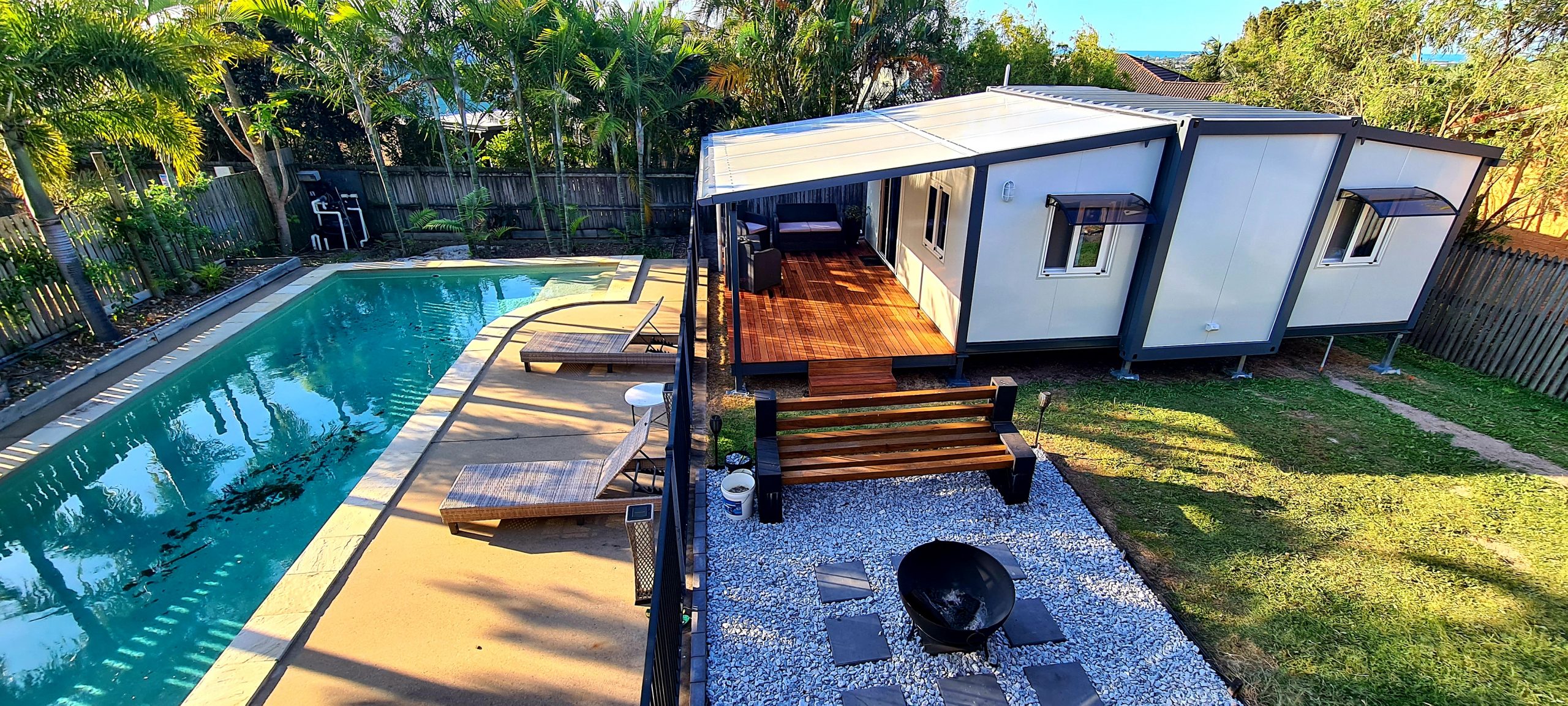
A Pop Up Home is incredibly versatile, occupying no more than 58 SQM of land. Pop Up Homes are a great return on investments.
Pop Up Homes is a leading provider of granny flats and small homes in Queensland. Packed with inclusions, our high quality 1,2 & 3 bedroom homes are a perfect option for customers looking to downsize or create additional rental income.
Frequently Asked Questions About Pop Up Homes
A.Yes, Pop Up Homes looks after all the planning and council approvals for you.
A. Yes, we have an experienced team of installers who install your home in 7-10 days.
A. Yes, we do the footings and connection of the footings to the homes. We use a surefoot footing system that does not leave your yard a mess, no concrete trucks and no bobcats and very little land preparations required.
A. Yes, we have had many homes passed through council, we work closely with our clients to ensure the certification and council process is a breeze.
A. There is a 7-year structural warranty.
A. Currently, we only deliver within Queensland.
For further information and exact pricing on our Pop Up Homes, please contact us on:
History Of The Melbourne Cup
Jockeys Club (1857). The Melbourne Cup was introduced in 1861 by the Victorian Turf Club to trump the success of Victorian Jockey Club races such as the Two Thousand Guineas. As a handicap race, the Melbourne Cup introduced a level of speculation that the club hoped would attract more entries and therefore higher prize money. The two competing organizations disbanded in 1864, before merging to form the Victorian Racing Club, which has controlled racing in Victoria and the Melbourne Cup ever since.
Although the Melbourne Cup today is well known in Australia for being run on the first Tuesday in November, this has not always been the case. The 1866 Melbourne Cup race was run on a Thursday, and in 1867 the Cup was run in October. It wasn’t until 1875 that the race was run on the first Tuesday of November.
When looking at building a Granny Flat in Queensland don’t think that the only option is to go through a conventional builder.
Pop Up Homes are a great alternative to a conventional build and will not only save you thousands but are a hassle-free way to build a Granny Flat. Granny Flats are becoming extremely popular in Queensland.
There are so many benefits to having a Granny Flat on your land. Granny Flats are great as an additional room for your extended family and are also a great way to increase your return on investment.
Why not use the land you already have to build a Pop Up Home, rather than go through the expense of buying another block of land to build on?
Think about all the benefits of utilising the land you already have. You will save on additional rates, water, insurance, let alone the additional mortgage.
At Pop Up Homes we are educating people on getting the most out of the land you already have. How will it affect you and your family when the interest rates rise?
Don’t leave it until it’s too late.
The average rental return on a 1-bedroom Granny Flat in Queensland is approximately $250 p/w. Think about how that will help you either pay down your mortgage or substitute your current and future income.
We have a lot of customers who Airbnb their Pop Up Homes and are generating an additional income of $75 a day, yes that is $525 per week. Being that these homes are so unique everyone wants to stay in one.
Pop Up Homes are the most affordable way of owning a Granny Flat, they are a fast and easy way to build and is very affordable.
The install time usually takes 7-12days. The Pop Up Homes are transported to site on a tilt tray, we use a small crane to place them on your stumps, keeping the transport costs to a minimum to make it affordable for you.
Our Pop Up Homes are well insulated, they look great and are extremely affordable and are made to suit the Queensland weather.
They are cyclone rated, cool in summer and warm in winter, council certifiable, 7-year structural warranty and can be completely off-grid.
Starting from $41,990, Pop Up Homes offer three styles of small home/granny flat solutions.
The Keppel 1 bedroom.
Starts from $41,990 – 37 square metre consist of 1 large 12.5 SQM Bedroom. The open plan living makes the home feel very spacious. The price of this home includes one bedroom, bathroom with a shower, toilet, vanity, shaving cabinets and towel rails.
The kitchen consists of a 3.8m gloss kitchen with soft closing doors and drawers and a handmade stone benchtop.
The Fraser 2 bedrooms or 2 bedrooms with study.
Starts from $54,990– 58 square metre consist of 2 spacious 10.6 sqm bedrooms. An open plan living with a fabulous 3.8m kitchen with soft closing doors and handmade stone benchtop.
The bathrooms have a 900×900 shower cubicle with a vanity, toilet, towel rails and a shaving cabinet.
The Moreton 3 bedroom.
starts from $55,990 – 58 square metres consist of 1 large 7.55 sqm and 2x 6.5 sqm bedrooms. It is ideal for a small family. It has a large open plan living area. With a modest bathroom that consists of a large 900×900 shower, vanity, toilet, towel rails and a mirrored stainless steel shaving cabinet.
The Moreton comes with a 3.8m kitchen with soft closing doors and handmade stone benchtop.
If you would like more information or enquiries on our style of Pop Up Homes, do not hesitate to contact the team on 1300 121 556.
Would you like more information on what type of Pop Up Homes styles we offer, click HERE
For information about investments with a Pop Up Homes, click HERE
Not sure if you can put a Pop Up Home in your back yard? This ARTICLEwill tell you if you can.
Check OutBMSAfor more information on our footing system.
Note** Return on Investments are approximated only and may change based on your circumstances.
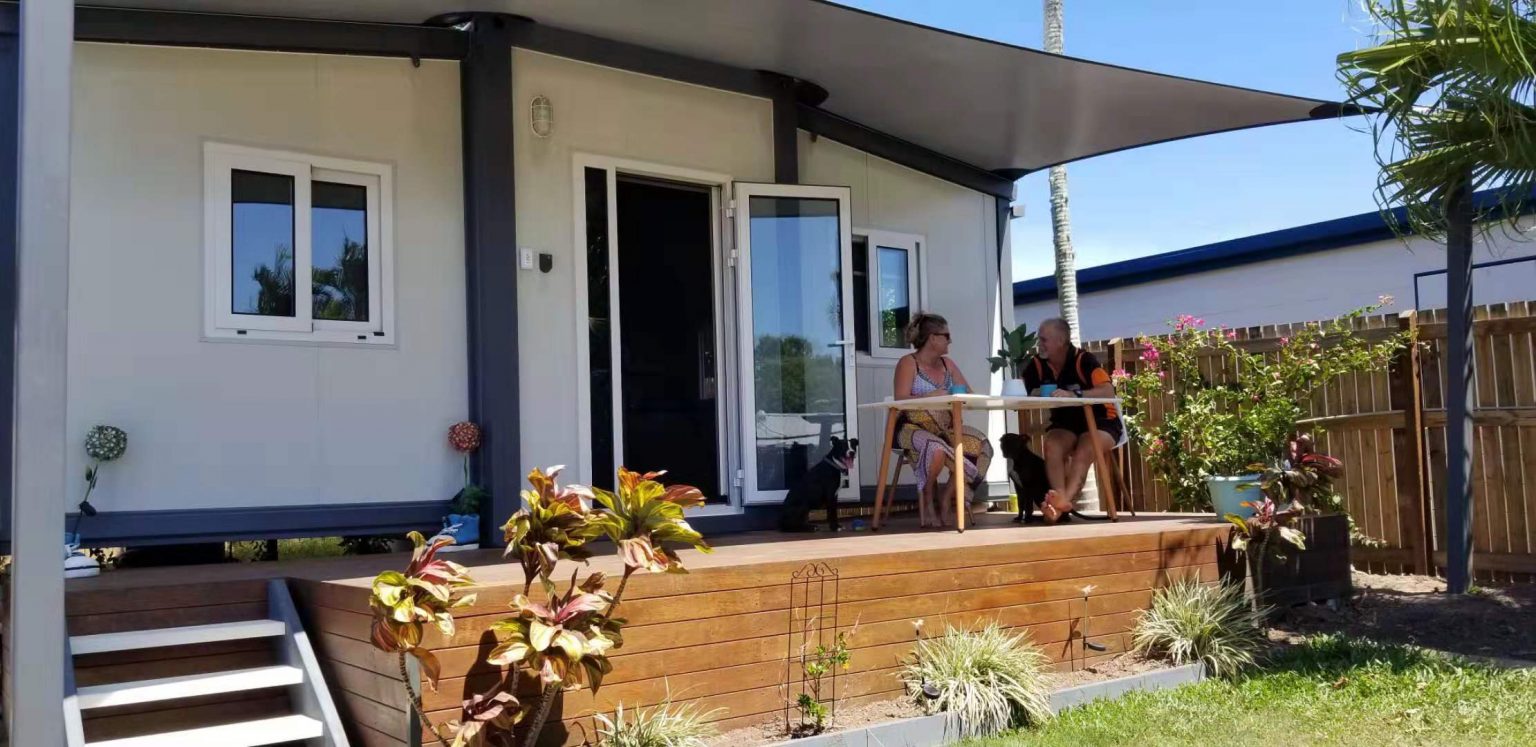
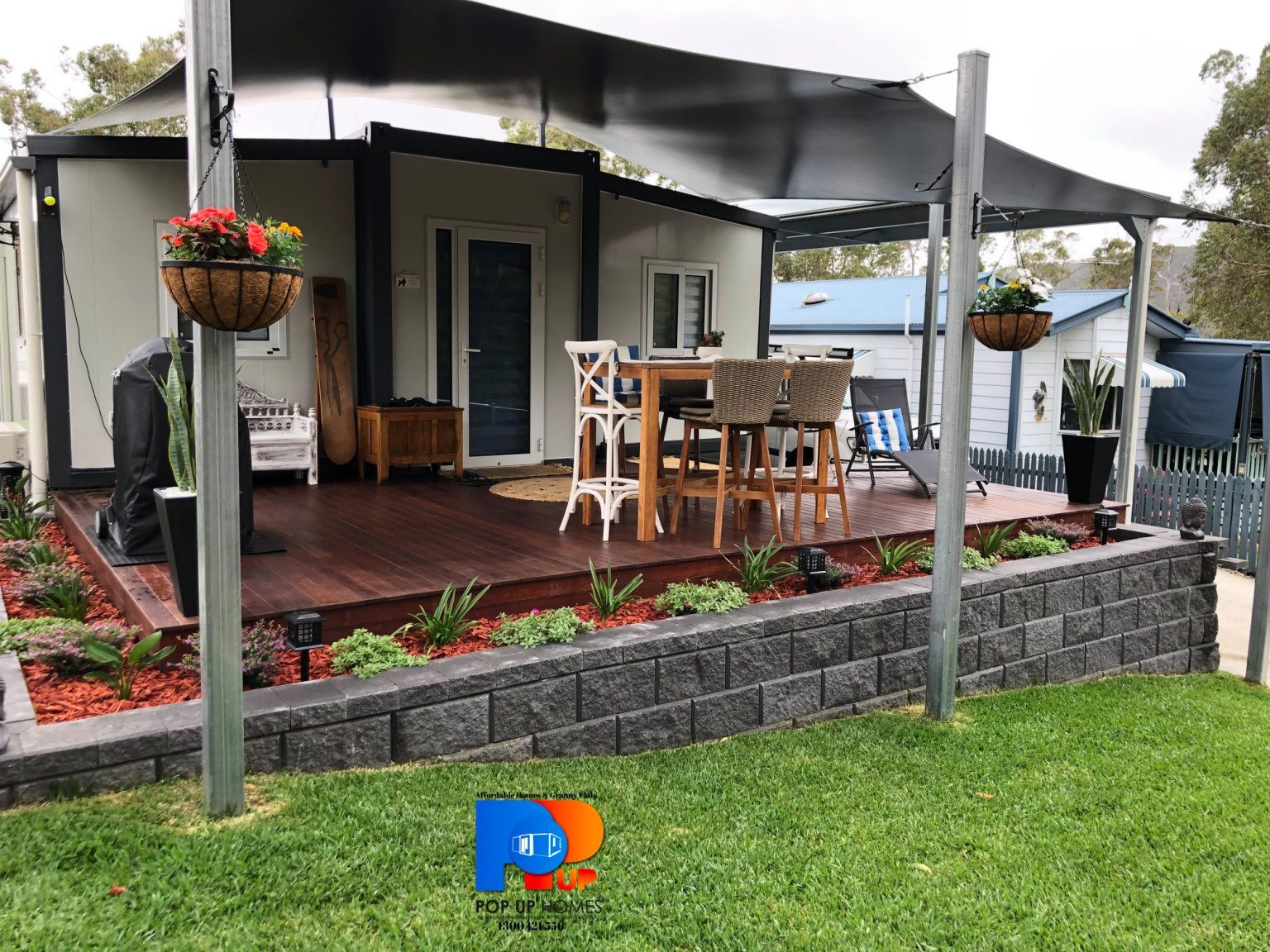
A Pop Up Home can be an affordable instant source of extra income; a clever downsizing option; comfortable accommodation for adult children or elderly parents; or a convenient home office, while increasing the total value of your property.
Adding a Pop Up Home investment not only increases the value of a property but also provides positive rental returns. Retirees are now opting to downsize into a Pop Up Home leaving their larger home to rent out or for their children to live in.
A Pop Up Home is an ideal solution for young singles to have their own space while allowing them to save to buy their own home. It has all the workspace they need with the convenience and cost savings of being just meters from home.
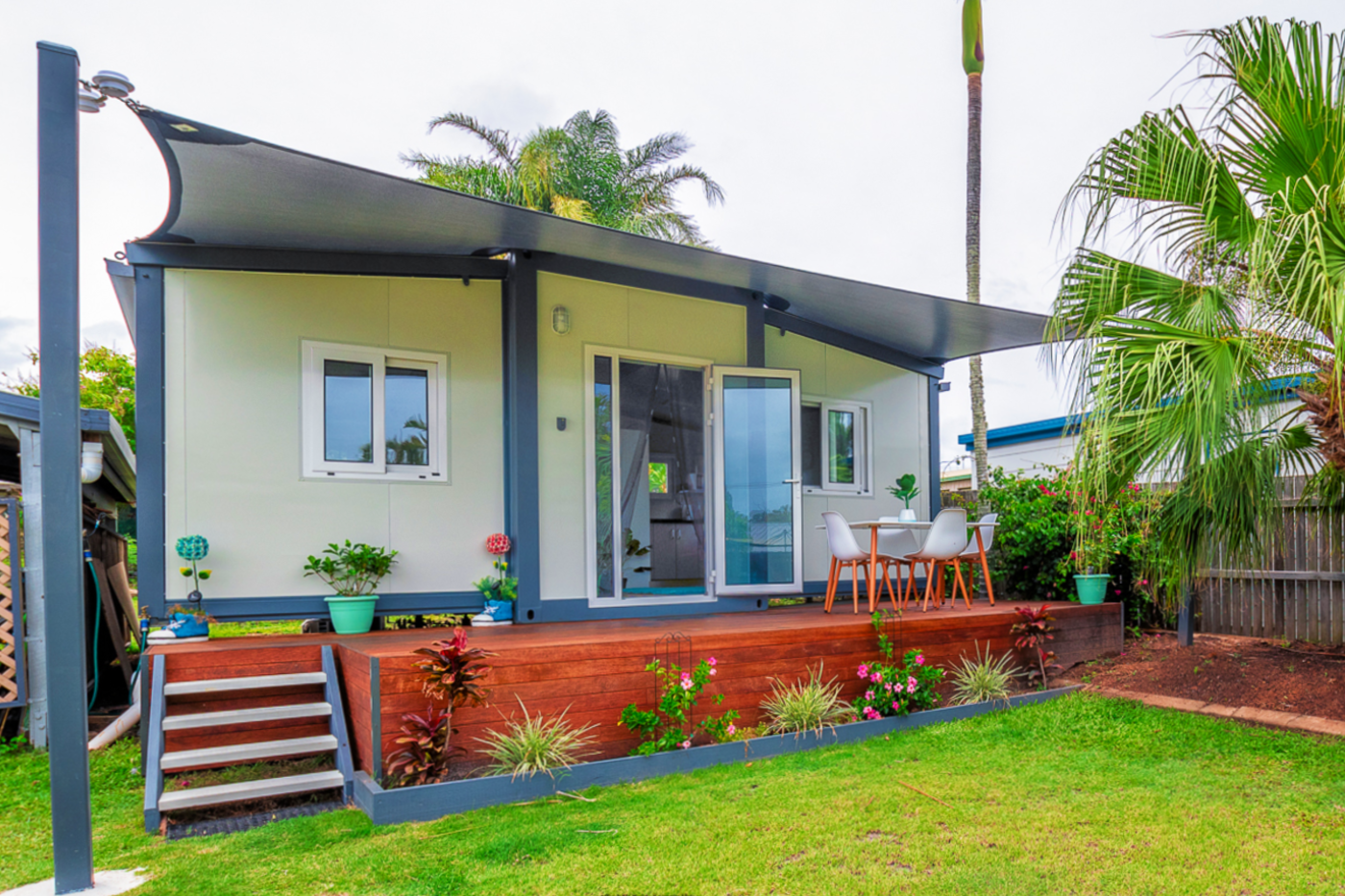
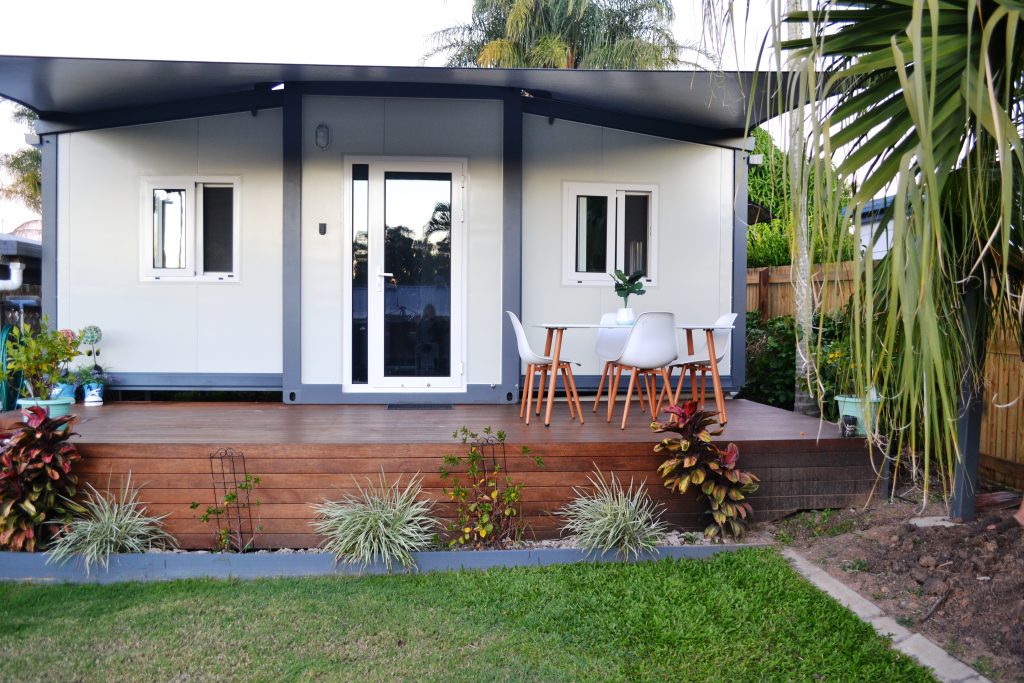
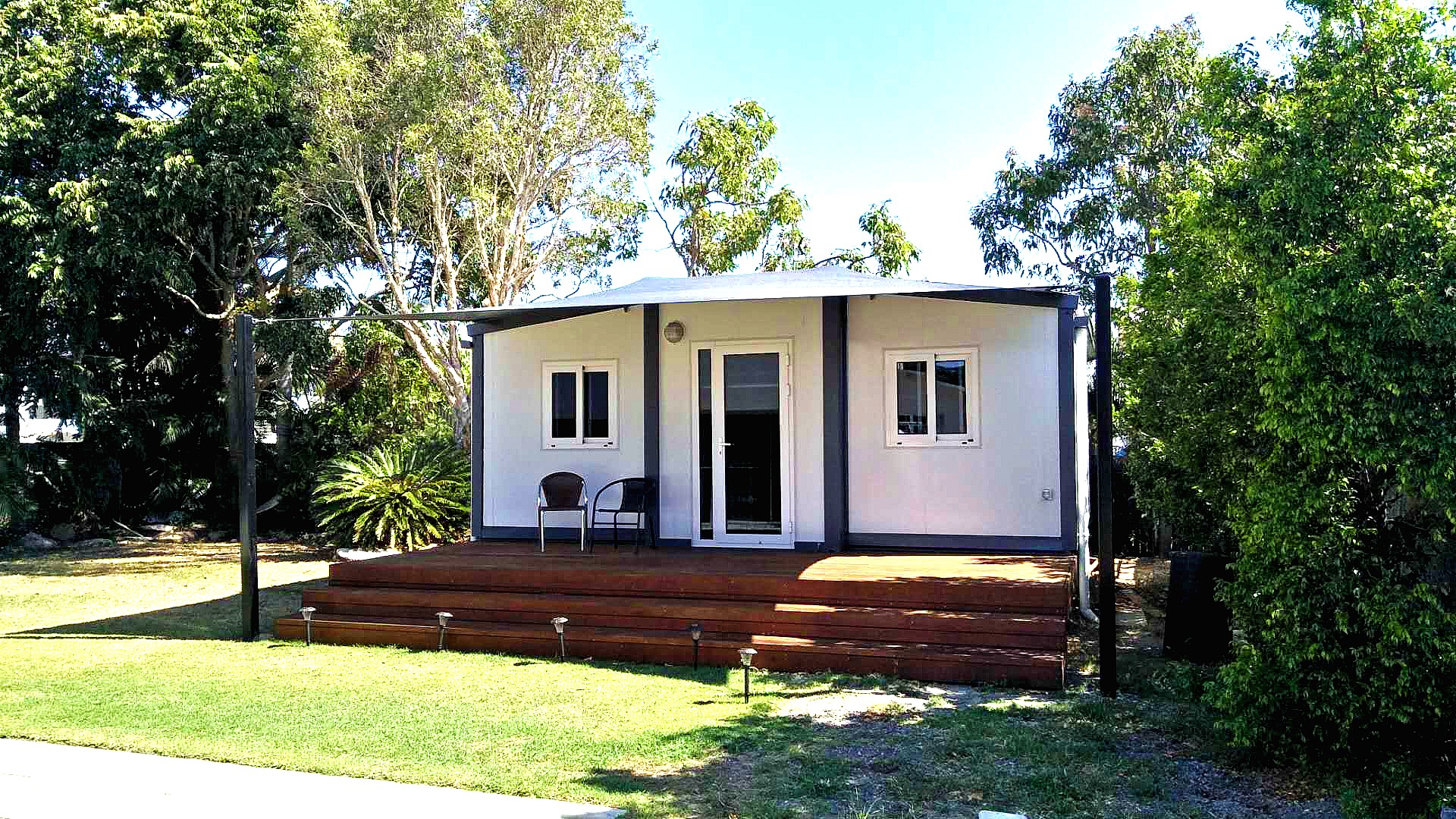
The Keppel 37 SQM 1 Bedroom
The team from Pop Up Homes, will sit down with you and discuss your requirements and help design your floor plan and achieve your goals.
Pop Up Homes will also help with your council approvals and certification as part of an affordable service that Pop Up Homes provide to customers.
All Pop Up Homes include:
Double glazed aluminium windows with flyscreens
Double Glazed aluminium casement door with glass panel
Quality PVC floor covering throughout
Lights, power points, power board and safety switch
Plumbing and Sanitary fittings
Photoelectric hard wired smoke detectors as per Australian Standards
All Pop Up Homes Kitchens include:
Gloss cabinets and drawers
Polished stone Benchtops
Double stainless steel sink & flick mixer
All Pop Up Homes Bathrooms include:
900 x 900 Shower cubicle
Toilet suite
Vanity cabinet with basin and flick mixer
Mirrored shaving cabinet
Towel rails
For more information on Pop Up Homes, please call for more information on:1300 121 556
Would you like to know more about council regulations?
ANZAC day is fast approaching. On the 25 of April is one of Australia’s most important national occasions.
For the first time in Australia’s history, due to the COVID-19 restrictions our communities will not be able to pay our respects to the ANZAC spirit in public.
However, this does not mean we can’t show our respects in the safety of our homes.
The team at Pop Up Homes will be doing a “light up the dawn on ANZAC day”.
You can too; simply stand at the end of your driveway, balcony or living room at 6 am on Saturday the 25th of April and play a digital recording of the dawn service.
Recently, Pop Up Homes has received a few emails from the public requesting our opinion in relation to a building project they are undertaking. In most cases, they have bought pre-fabricated houses from companies that claim are similar to a Pop Up Home but in actual fact, entirely different. Consequently, now have been left with homes that are unhabitable, non-certifiable and non-compliant with the Australian/New Zealand building standards.
If your house is non-compliant to Australian/New Zealand standards and can’t provide engineering and certification, your prefabricated home will be deemed unliveable, and the council will ask you to remove the dwelling at your cost. By this time, you will have already invested significant funds that in most cases, won’t be recoverable.
The purpose of this article is to inform readers about the seriousness of asking questions before buying and building a home. These simple “must ask” questions apply to many aspects of the building industry whether you are buying prefabricated buildings, modular buildings, conventional building and granny flats. Ensure you ask these questions before you commit to purchasing, they are designed to provide you, the buyer, with peace-of-mind.
Ask these questions when enquiring on Buying or building a pre-fabricated building
Is this a class 1A dwelling?
Have you had any issues getting the home certified?
Can they be certified in QLD?
Do you have any customer testimonials I can read?
Does your prefabricated and modular home come with a form 15 engineers design certificate? this is required for council approval and reassures you that it is structurally sound.
Does your plumbing for waste and sewerage conform to Australian standards and does your plumber use DWV pipe?
Does your prefabricated and modular home come with hard-wired smoke detectors? can you supply form 16 for this? this will be required for certification.
Do your prefabricated and modular homes come with Australian certified windows, do they also come with a form 15 and form 16 for design and installation?
Do you have a prefabricated or modular display home that we can view?
Can we view your certification for your display home?
Are the ceilings in the prefabricated home or modular home at least 2400mm high? They need to be, for it to be a habitable building in Australia.
Have you been informed, that there is no requirement for a laundry to be installed for a granny flat?
Does your prefabricated or modular home come with a warranty? Can I see a copy of your warranty?
Is your certification cost inclusive to the quote?
Does your prefabricated or modular home require stumps or foundation?
Does your prefabricated or modular home stumps/foundation come with form 15-16 design and installation certificates?
established Pop Up home to lock up stage
The Keppel 1 bedroom
Always be wary
Always be wary when purchasing a pre-fabricated building, modular home or granny flat, make sure what you plan on purchasing is exactly what was advertised from the builder.
Asking these easy set of questions will alleviate stress, uncertainty and doubt from your mind. It will ensure that what you’re buying is exactly what you have seen as advertised.
As I have always said to myself “if it’s too good to be true, then it isn’t”
The team at Pop Up Homes is very experienced when it comes to the build process and requirements. Not only can we answer all questions as mentioned above, but we can also provide evidence of certification, testimonials, video reviews from customers as well as warranty and forms 15, 16 and 21. We also have a display home right here in Hervey Bay, Urangan to come and have a look though.
Pop Up Homes exists to provide excellent customer service, an affordable housing solution and the very best experience possible. Pop Up Homes will assist you in every way we can to save you cost without sacrificing quality.
Please watch this TV interview with Shan, our Managing Director of Pop Up Homes and Channel 7 news for more information about being careful when purchasing prefabricated and modular buildings.
Click Home button below:
https://popuphomes.com.au/
Channel & interview
For more information
If you would like to know more about our homes, please don’t hesitate to contact us through our web page www.popuphomes.com.au or alternatively, you can call our toll free number on 1300 121 556.
Would you like to look at customers reviews or to see what our Pop Up Homes are all about? you can check our Facebook page for more information, or you can Google search “Pop Up Homes”
Whether you’re getting a foot in the door, in the housing market or a veteran investor. It pays to have quality insight in areas that are tipped to boom around Australia.
What factors can make a property market boom?
There are a few factors that can make the property market boom. The biggest factor is the State Governments spending on infrastructure, such as public transport, hospitals, universities and roads.
The Queensland Government “state infrastructure plan” outlines the Queensland Government strategic direction for planning. Prioritising the investment and delivery of infrastructure that supports growth, enables economic development and create jobs.
The Queensland state infrastructure plan is investing $49.5 billion over the next four years to boost the Queensland infrastructure. Not only is this good for the housing market but it’s beneficial for our economy.
As mentioned in the “Queensland state infrastructure plan” the plan for 2019-2020 is to allocate $12.9 billion for expenditure on public infrastructure. Supporting an estimated 40,500 jobs.
Queensland state infrastructure plan mentioned that about 60 per cent of the capital program and 25,500 of the jobs supported are outside the Greater Brisbane area.
Transport projects will improve traffic flow and relieve congestion, enhance public transport services, and increase the productivity and efficiency of freight around the state.
Critical infrastructure that ensures current and future generations of Queenslanders have access to world-class health and education services. Will be provided through programs such as Enhancing Regional Hospitals and the Building Future Schools Fund.
The government will continue investing in regions to ensure all Queenslanders can access the frontline services they rely upon. To ensure Queensland remains an attractive place to live and for businesses to invest in
Top 10 property hotspots around Australia
According to “Hotspotting”, these are the top 10 property hotspots around Australia.
Sunshine Coast, Queensland.
Marion, South Australia.
Bendigo, Victoria.
Moreton Bay Region, Queensland.
Stirling, Western Australia.
Darebin, Victoria.
Port Adelaide Enfield, South Australia.
Mackay, Queensland.
Joondalup, Western Australia.
Latrobe Valley, Victoria.
Sunshine Coast, Queensland.
Located: 100km north of Brisbane, stretching 55km from Caloundra to Noosa.
May suit: Retirees, but growth is likely to be seen in the number of younger people.
Strong performers: Maroochydore south to Caloundra. Noosa heads the local unit market and has had the highest unit growth in the nation at 24% so far in 2019. While Golden Beach and Warana are up 15%. Median house prices in the area have also grown in the past year (October 2018 to October 2019), particularly in Eumundi (+26%), Sunshine Beach (+15%), Twin Waters (+15%) and Wurtulla (+15%).
Property profile: There are still locations with median house prices below $500,000 in Caloundra West, Kawana and Nambour. The Noosa property market is making a comeback, with particular interest from Sydney and Melbourne investors, according to Hotspotting. Vacancy rates are well below 3% across the Sunshine Coast.
Local economy: Economy expanded from its three dominant sectors – tourism, retail and construction – into information technology, clean-tech (otherwise known as clean technology, which is a term used to describe products or services that are environmentally friendly), creative industries, aviation and education.
Projects boosting capital growth prospects include The new University Hospital, the Maroochydore CBD project, the Sunshine Coast International Airport to be completed in 2020 and ongoing upgrades to the Bruce Highway.
Moreton Bay Region, Queensland
Located: Around 50km north of the Brisbane CBD.
May suit: Investors looking for affordable prices, low vacancies and high rental yields.
Strong performers: Suburbs that recorded good price growth in the past year included Woody Point (+8%), Strathpine (+7%) and Bray Park, Burpengary East, Murrumba Downs, Narangba and Petrie were all up by around 5%.
Property profile: Most of the area’s suburbs have median house prices below $500,000 and several in the $300,000s. There are still large amounts of vacant land to support rapid population growth.
Local economy: The Caboolture area, in particular, has changed in recent decades from a former agricultural centre and timber-led industry into an urban village. Moreton Bay’s major centres all have fairly easy access to the Brisbane CBD, Brisbane Airport and major transport routes.
Projects boosting capital growth prospects include New University of the Sunshine Coast (USC) Moreton Bay campus (at Petrie) to open in 2020, Moreton Bay Rail Link, North East Business Park and the proposed Caboolture West Master Plan, a large-scale development which could accommodate around 70,000 residents.
Mackay, Queensland
Located: Around 950km north of Brisbane in Central Queensland, near the Whitsunday Islands.
May suit: Investors and first home buyers looking for housing affordability and job opportunities.
Strong performers: Hotspotting said positive property trends have included strong median house price growth over the past year in Mt Pleasant (+21%), Sarina (+15%) and West Mackay (+13%).
Property profile: Mackay had the strongest house price growth of any region in Queensland in the year to March 2019, and vacancy and unemployment rates are falling. Houses are selling in around 70-80 days or faster, compared to around 200 days (and even over 300 in some cases) in 2016, according to Hotspotting. The resources sector is capable of causing volatility in this market.
Local economy: The property market in Mackay was impacted by the mining bust but is now recovering. The local economy is diversifying from being heavily driven by mining for employment, as in the past, to other sectors such as construction, logistics, agribusiness and tourism (being located fairly close to the Whitsunday Islands).
Projects boosting capital growth prospects include Qantas’ pilot training academy, construction of the Mackay Ring Road, around $1.3 billion in funding for road infrastructure upgrades in the Mackay region between now and 2022 and the rebuilding of Cyclone Yasi-impacted Lindeman Island resort, which is in the Mackay local government area.
Pop Up Homes is your solution
for an affordable granny flat, not only for investment purposes to increase the value of your property but for your parents, grandparent and adult children that are wanting to live closer to their family or saving for their first home, while providing that privacy that we all need. We offer 2 sizes; – 37 square metres and a 58 square metre with 4 different styles.
There is a trend in Australia that is taking hold, gone are the days of “bigger is better”. The younger Australian generations are looking more into Small Homes for affordability. The average size for a Small Home is between 30 square metres and 40 square metres of living space.
While the older generations of Australians no longer need that “big” home, their kids are mostly all grown up and moved on with their lives and have their own families. This gives the older generations of Australians a chance to downsize and unlock equity to live a better retirement, go travelling and live a comfortable life without worrying about finances.
There are other reasons to downsizing as well, sometimes you’re being forced to downsize because you might have lost your job or need to relocate or other life-changing events. Downsizing has many benefits, these include saving money on power and electrical, upkeep and maintenance and smaller workloads typically associated with larger homes. All these benefits sum up a much more enjoyable and stress-free life.
Let’s be serious the more space you have in your home the more you feel like you need to fill every nook and cranny with materialistic objects to make it a home. One of the benefits to downsizing your home is that you don’t need to fill every space with objects, Save money rather than waste money on electronics, electrical appliances, furniture and small household items that are space fillers and dust collectors. Downsizing to a Small Home will not only help you prioritise your life, but it will make you bring only the necessary items to your new small home.
Enjoying the benefits of downsizing:
Many homeowners that own a “big” home agree that living in a “big” home can be stressful with upkeep, cleaning, maintenance, furnishing, outdoor upkeep and the cost to run all these factors can lead to a stressful home. Downsizing is a great option and can be the first step to streamlining your life. You will be surprised that reducing your daily chores on maintenance will free up your time for activities that you want to do, spending time with family, getting more rest, going travelling and SAVING money.
Save on energy costs when downsizing your home:
We all know the cost of electricity when trying to keep your “big” house cooler in the summer or warm in the winter. It costs a lot to run a “big” house when you start adding up the bills. Downsizing will give you the added benefit of reducing your carbon footprint while enjoying the savings in a lower power and water bill.
Downsizing can free up your lifestyle for travelling:
Reduce bills, and unlocking your equity, Presto you have that extra spending money to go on those trips you have dreamed of going but couldn’t because of money tied up in your “big” house.
Downsizing can open a new chapter in your life:
For many homeowners downsizing their home can be a new chapter in your life. Whether your kids have finally left the nest to live their own lives or have suffered a loss from a spouse or close roommate. Downsizing can represent a way to start a new life in a new home.
Splurge on a few key furniture pieces for your small home:
Many people that consider downsizing think that they can’t make their home fabulous, think again! Some of the greatest Small Homes are ones that have style and creative uses of space and proportions. Splurge on a few key pieces like a dynamic coloured couch that draws attention to your décor and not the size of your room. There are many space-saving furniture ideas that people have come up and for you to explore in your new small home.
A simplified lifestyle will help keep you out of debt
Living a simple stress-free life is what most people whelm to have or do, Less debt, less stress, less maintenance yet still room for family and friends.
We speak to a lot of our customers that have downsized into a pop up home and they say, “life could not be better” Downsizing does not mean that you are missing out on anything, you are gaining a life, often debt-free.
Every state and territory in Australia has its own first homeowner’s grant, each state has its grant amounts and requirements. Queensland is the most generous offering up to $5000 more than NSW, SA and Victoria.
At the start of the new millennium in July, marks the year that owning a home become significantly more accessible in Australia. In July 2000 the Australian government introduced the first homeowner’s buyers grant. This nationwide initiative that was introduced to offset GST and make purchasing a home more affordable for Australian citizens.
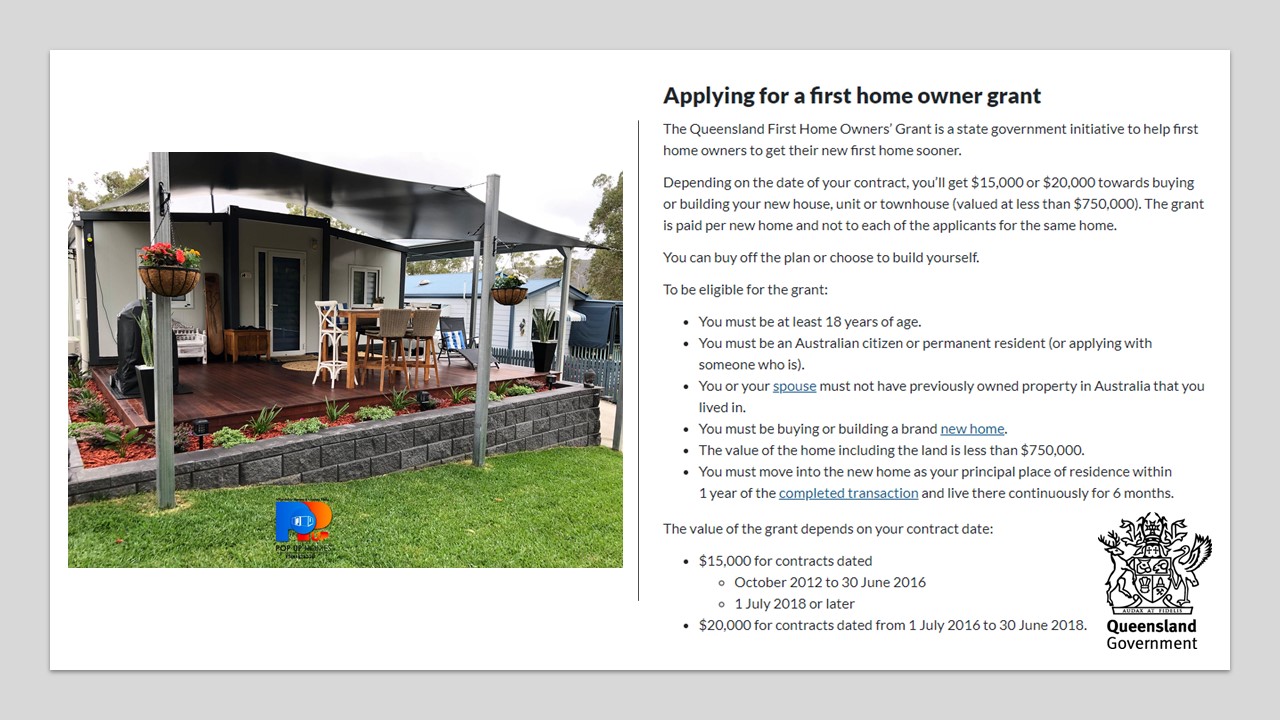
The first homeowners grant is an initiative by the Queensland government, to make it easier for eligible individuals, couples and families to own their first home. You can get $15,000 towards buying or building your new house, unit or townhouse as long as it is valued less than $750,000. The grant is paid per new home, not to each of the applicants for the same home.
What is the criteria to become eligible for the first homeowner’s buyers grant?
To be able to get the first homeowners grant you must be,
At least 18 years of age.
Must be an Australian citizen or permanent resident. (or applying with someone who is)
You or your spouse must not have previously owned property in Australia that you lived in.
You must be buying or building a new home. A new home is either a house, unit or townhouse that has never been occupied as a place of residence or sold as a place of residence.
You may use the first homeowner’s buyers grant on a *substantially renovated home including the land it’s situated on. There is a criterion that needs to be met before the release of the grant.
It must be substantially renovated before you buy it.
Must not have a been lived in since the renovation.
The seller:
Must be registered for GST and be selling the home in the course of their business.
The seller must give you a tax invoice that shows the GST component of the home purchase price.
Must give a statement that confirms the house has not been occupied or sold since renovation.
*Substantial renovations definition: A substantial renovation is when all, or most, of the structural or non-structural components of the building, are removed or replaced. Most of the rooms in the building must have been affected, and the renovations must have affected the building as a whole for it to be considered a substantial renovation.
You must live in your new home as the principal place of residence within 12 months of the completed transaction and live there continuously for 6 months.
The value of the new house and including the land must be less than $750,000.
Must be buying in Queensland.
The new home cannot be in a family trust.
You must not receive financial help to build or buy your new home, from a related person who also will regularly stay in the home.
Unless you are an owner-builder, you must have signed a contract to buy or build your first home before applying.
When do you get your first homeowner’s grant?
When you’re are eligible for the first homeowner’s buyers grant, you will receive the homeowners grant once you have;
Begin building a new home
Signed a building contract for your new home.
Put down a deposit for a block of land. This must be done before signing the building contract.
Registration statement that identifies the applicants as the registered owners.
Final inspection certificate.
Valuation notice.
Rates notice.
Buying a new home
Contract signed and dated by the seller and applicants.
Final inspection certificate.
Registration statement that confirms the applicant as the registered owners of the new home.
Statement from the seller confirming that the property hasn’t been previously been occupied or sold as a place of residence.
Stamped and lodged form 1 transfer.
Please note that that your application submission must occur within 12 months of the new home completion, and the final inspection report delivery.
Did you know?
Pop Up Homes are not only granny flats; our homes can also be used as a main dwelling. Additionally, you can use a Pop Up Home for your first homeowner’s buyer grant as you will be building a new home, as long as you have your block of land before signing the builders contract you will be eligible for the first home owners buyers grant.
Pop Up Homes have 3 modern styles to choose from and come in 2 sizes. The size ranges from 37 square metres to 58 square metres. The 3 modern styles to choose from include,
The Keppel 1 bedroom 37 square metres, Price starts from $39,990.
The Fraser 2 bedroom 58 square metres, Price starts from $49,990.
The Moreton 3 bedroom 58 square metres, Price starts from $51,990.
A Pop Up Home is an affordable solution for the young and old and a good way to get your foot in the door in the housing market.
Contact Pop Up Homes on 1300 121 556 now for your free consolation with one of our Pop Up Home specialists.

 1300 121 556







 office@popuphomes.com.au